
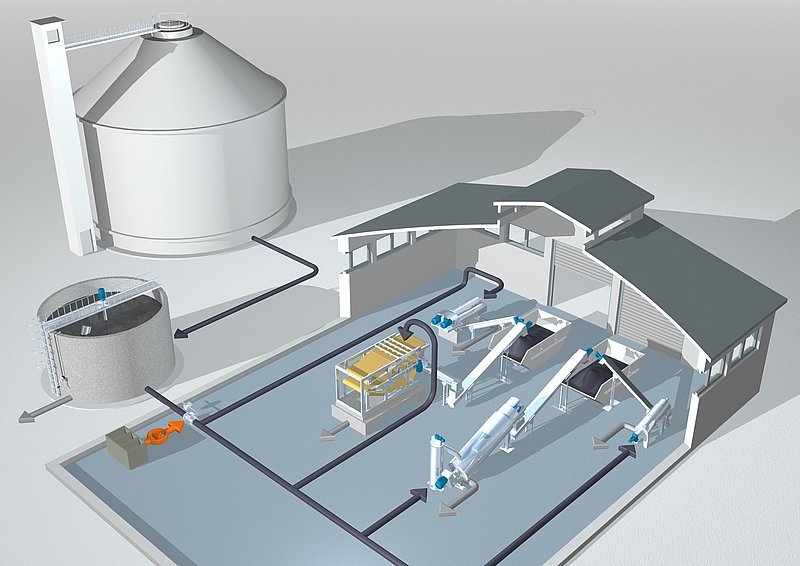
In large industrial facilities, sludge volumes rarely remain static. As throughput increases, so does the volume of residual solids requiring treatment. At that point, sludge dewatering shifts from a background utility to a central operational control point. Storage capacity, transport frequency, disposal costs and compliance risk all depend on how effectively water is removed from solids.
A reliable sludge dewatering system is not defined by machine size alone. Performance depends on feed stability, conditioning response and mechanical separation working together under continuous load.
Understanding each stage makes large-scale operations more predictable and less reactive.
Why Sludge Dewatering Matters at Scale
Industrial sectors such as wastewater treatment, food processing, manufacturing and mining generate residual solids that must be separated from liquid streams before discharge or disposal.
Sludge typically contains a high proportion of water. Without effective dewatering:
- Transport volumes increase
- Disposal costs escalate
- Storage capacity is reduced
- Handling classification may change
- Receiving facilities may reject loads
For example, increasing cake solids from 18 percent to 25 percent can significantly reduce haulage frequency over a month. That difference directly impacts operating cost.
Dewatering is not just a treatment step. It is a logistics and compliance control point.
Feed Stability Comes First
Large-scale dewatering equipment performs best when feed solids remain within a controlled range.
Rapid fluctuations between dilute and concentrated sludge create operational instability. Operators may respond by:
- Increasing polymer dose
- Adjusting centrifuge torque limits
- Modifying belt speed
- Altering press cycle time
These reactive adjustments increase chemical use and mechanical wear.
Stabilising feed through buffer tanks or controlled discharge sequencing reduces the need for constant recalibration.
If cake dryness varies unexpectedly, checking feed solids concentration is often more effective than adjusting the machine.
Thickening Limits Downstream Efficiency
Pre-thickening reduces hydraulic load before mechanical separation begins.
When thickening underperforms:
- Polymer demand increases
- Separation efficiency drops
- Cake dryness declines
- Energy consumption rises
For example, feeding a centrifuge with poorly thickened sludge increases rotational load while still processing excess water. The machine continues operating but works less efficiently.
Optimising thickening upstream protects downstream capacity.
Conditioning Sets Separation Behaviour
Polymer selection and dosing determine how solids bind and how water releases.
Effective conditioning produces:
- Defined floc structure
- Clear centrate or filtrate
- Consistent cake formation
- Reduced blinding or smearing
Poor conditioning leads to:
- Belt fouling
- Increased torque load
- Inconsistent cake solids
- Higher wash-down requirements
At scale, small polymer inefficiencies compound quickly.
For instance, a minor increase in polymer overuse across a continuous 24-hour operation may significantly raise monthly chemical costs.
Reviewing conditioning response before adjusting mechanical parameters often resolves performance issues more efficiently.
Mechanical Separation Technologies
Industrial facilities typically rely on three primary technologies for sludge dewatering.
Centrifuges
Centrifuges separate solids and liquid using centrifugal force in a closed system.
They are commonly installed where:
- Continuous operation is required
- Operator attendance is limited
- Feed variability is expected
Centrifuges can handle higher hydraulic loads and fluctuating solids concentrations compared to some other systems. However, performance still depends on upstream stability.
Belt Presses
Belt presses remove water through gravity drainage followed by applied pressure.
They are suited to facilities where:
- Feed conditions remain stable
- Operators can monitor performance
- Polymer optimisation is ongoing
Belt presses are sensitive to conditioning quality. Poor floc formation often results in blinding and inconsistent cake formation.
Filter Presses
Filter presses operate in batch cycles and apply pressure to produce a drier cake.
They are typically selected when:
- Disposal volume must be minimised
- Cake must be stackable
- Solids content is critical for transport or reuse
While filter presses can achieve higher dryness, they require cycle management and sufficient upstream buffering.
Choosing between these technologies depends on throughput, operator availability and disposal requirements.
Handling, Transport and Compliance Impacts
Cake consistency directly affects transport and acceptance criteria.
Material that cannot hold its shape may require:
- Enclosed transport
- Containment controls
- Restricted loading procedures
Receiving facilities, composting sites and land application programs commonly specify minimum solids content.
Facilities often notice dewatering issues first through:
- Increased truck movements
- Rejected loads
- Rising disposal charges
Monitoring cake solids consistently protects downstream logistics.
A Typical Operating Issue
Consider a centrifuge running at constant speed with rising polymer consumption and increasing cake moisture. No alarms are triggered, and mechanical components appear functional.
In many cases, the cause is upstream:
- Reduced feed solids
- Changed sludge chemistry
- Poor polymer mixing
Adjusting torque or speed may provide temporary relief, but reviewing feed and conditioning typically resolves the issue more efficiently.
This illustrates why sludge dewatering must be assessed as a sequence rather than as a standalone machine.
Reading the Dewatering Line as a System
Each stage influences the next.
A drop in thickener performance increases hydraulic load. Higher hydraulic load reduces centrifuge efficiency. Lower cake solids increase disposal frequency. Increased transport affects overall plant operating cost.
Reviewing the entire line helps prevent reactive troubleshooting.
When evaluating or improving Sludge Dewatering Processes, it is important to assess:
- Feed solids stability
- Thickening performance
- Conditioning response
- Mechanical separation efficiency
- Disposal outcomes
You can review practical operational considerations in more detail here:
Conclusion
Sludge dewatering in large-scale industrial facilities is not defined by equipment capacity alone. Performance depends on upstream control, stable conditioning and coordinated mechanical separation.
Feed variability, thickening efficiency and polymer response directly influence cake dryness, chemical usage and disposal cost. Treating dewatering as a system rather than a single unit reduces instability and improves long-term operating predictability.
At scale, small inefficiencies multiply quickly. A controlled, system-wide approach protects plant performance, compliance and cost management.
