
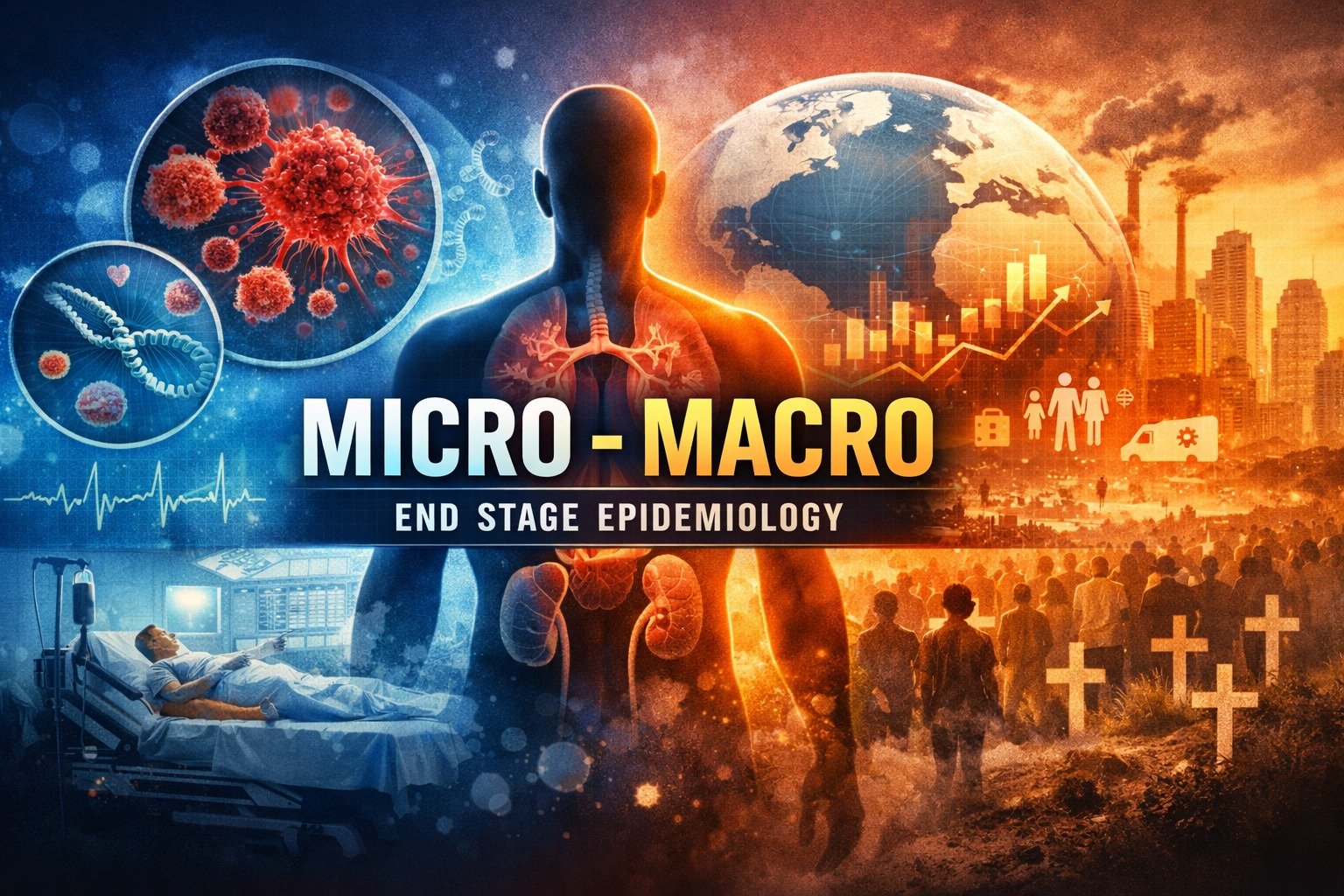
Micro macro end stage epidemiology is an integrated way of understanding how diseases develop, progress, and ultimately reach their most severe outcomes by connecting individual-level biological processes with population-level social and structural patterns. Traditional epidemiology often separates clinical mechanisms from public health trends, but this approach intentionally brings them together, recognizing that end-stage disease is never purely biological nor purely social. Instead, it emerges from continuous interaction between what happens inside the body and what happens around the individual in their environment, healthcare system, and society.
At its core, this framework helps explain why the same disease can have dramatically different end-stage outcomes across populations, regions, and socioeconomic groups, even when the biological diagnosis appears identical.
The Micro Dimension: Individual-Level Disease Progression
The micro aspect of micro macro end stage epidemiology focuses on disease processes occurring within the individual. This includes molecular, cellular, genetic, and physiological mechanisms that drive disease onset, progression, and eventual deterioration. At this level, epidemiology overlaps closely with clinical medicine and pathology, examining how risk factors such as genetics, immune response, metabolic changes, and comorbidities influence disease severity.
As diseases progress toward an end stage, micro-level factors become especially critical. Organ damage becomes irreversible, compensatory mechanisms fail, and treatments shift from curative intent to management and symptom control. Epidemiological analysis at this level studies survival probabilities, complication rates, biological markers of decline, and variations in treatment response. These individual pathways explain why some patients deteriorate rapidly while others remain stable for longer periods despite similar diagnoses.
Understanding the micro dimension is essential because it clarifies the biological limits of intervention and highlights points where earlier action could have altered the disease trajectory.
The Macro Dimension: Population-Level Patterns and Systems
The macro dimension examines disease across entire populations rather than individuals. It looks at how end-stage disease is distributed by age, gender, income, geography, ethnicity, and access to healthcare. Macro epidemiology also evaluates how policies, healthcare infrastructure, education, environmental exposure, and social inequality shape outcomes at scale.
At this level, end-stage disease becomes a measurable societal burden. Researchers analyze hospitalization rates, mortality trends, disability-adjusted life years, and healthcare costs associated with advanced illness. Macro-level data reveals patterns that individual clinical encounters cannot, such as why certain regions experience higher rates of late-stage diagnosis or why marginalized communities suffer disproportionate end-stage mortality.
Macro epidemiology shifts attention from individual failure to systemic responsibility, highlighting how delayed diagnosis, underfunded healthcare systems, or social deprivation can push diseases toward terminal outcomes that might otherwise have been prevented.
Defining End-Stage in Epidemiological Terms
End-stage disease refers to the final and most severe phase of illness, where functional decline becomes irreversible and survival is limited. From an epidemiological perspective, end-stage conditions are crucial because they account for the majority of disease-related deaths, long-term disability, and healthcare expenditure.
End-stage analysis goes beyond labeling disease severity; it measures timing, probability, and population impact. Epidemiologists study when patients typically enter end-stage phases, how long they survive afterward, and which interventions influence quality of life rather than cure. This perspective is particularly important for chronic diseases, where long-term management decisions significantly affect outcomes at both individual and societal levels.
By focusing on end-stage disease, epidemiology addresses the consequences of cumulative risk exposure over time rather than isolated health events.
How Micro and Macro Forces Interact at End Stage
The defining strength of micro macro end stage epidemiology lies in explaining interaction rather than isolation. Individual biological vulnerability does not exist independently of social context, and population trends cannot be understood without biological realities.
For example, a patient’s genetic predisposition or immune weakness may accelerate disease progression, but inadequate healthcare access, delayed screening, or financial barriers can determine whether that progression reaches an end stage prematurely. Similarly, environmental exposure and occupational risk may increase population-level disease burden, yet only certain individuals progress to terminal stages due to specific micro-level susceptibilities.
This interaction explains why prevention strategies that ignore social determinants often fail, and why healthcare policies that overlook biological variation can be inefficient or inequitable. End-stage outcomes represent the cumulative result of micro and macro influences acting together over time.
Relevance to Chronic and Global Diseases
Micro macro end stage epidemiology is especially relevant in the study of chronic and non-communicable diseases. These conditions develop slowly, interact with lifestyle and environment, and often culminate in prolonged end-stage care. From a global health perspective, this framework helps explain why low- and middle-income regions experience higher end-stage mortality despite lower reported disease prevalence, often due to late diagnosis and limited treatment access.
It also applies to aging populations, where increasing life expectancy amplifies the prevalence of end-stage disease. Epidemiologists use this approach to forecast healthcare demand, plan long-term care infrastructure, and design interventions aimed at delaying progression rather than merely extending survival.
By integrating micro and macro perspectives, researchers gain a more realistic understanding of disease burden across diverse populations.
Implications for Public Health Policy and Prevention
One of the most important contributions of micro macro end stage epidemiology is its impact on policy and prevention. By identifying where biological risk intersects with social disadvantage, public health strategies can be designed to intervene earlier and more effectively.
This framework supports targeted screening programs, resource allocation to high-risk communities, and integrated care models that address both medical and social needs. It also emphasizes the importance of data systems that link clinical outcomes with socioeconomic indicators, enabling policymakers to track not just who gets sick, but why diseases reach terminal stages in specific populations.
Ultimately, this approach reframes end-stage disease as a preventable outcome rather than an inevitable one, shifting the focus from crisis response to long-term risk reduction.
Why This Concept Matters for Modern Epidemiology
Modern epidemiology increasingly recognizes that health outcomes cannot be explained by single causes. Micro macro end stage epidemiology reflects this evolution by offering a holistic model that connects biology, behavior, systems, and society. It encourages collaboration between clinicians, public health professionals, policymakers, and social scientists, creating a shared language for understanding complex disease pathways.
As healthcare systems face rising chronic disease burden and aging populations, this framework provides essential insight into how interventions at different levels can change end-stage outcomes. It also highlights ethical considerations, reminding societies that disparities in end-stage disease reflect collective choices as much as individual risk.
Final Thoughts
Micro macro end stage epidemiology provides a comprehensive lens through which disease progression can be understood from the smallest biological mechanisms to the largest societal forces. By linking individual vulnerability with population patterns and focusing on the final stages of disease, it helps explain unequal outcomes, guides prevention strategies, and informs more equitable health policies. At a time when chronic and complex diseases dominate global health challenges, this integrated approach offers clarity, depth, and practical relevance for researchers and decision-makers alike, and it aligns closely with the kind of in-depth, explanatory health coverage published on Newtly.
