
Air source heat pumps are becoming more popular across the UK than ever. But with their growing popularity, an enormous number of myths and misconceptions have gathered pace. Some believe that they do not work in cold weather. Others believe they are noisy, too expensive, or for brand new houses only.
The truth is very different. In fact, air source heat pumps are one of the most efficient ways to heat a home. And with government help such as Heat Pump Grants, they are more affordable than many homeowners realise.
Let’s clear up common myths about air source heat pumps. By the end of this blog, you will know the facts and be able to decide if one is right for your home.
Myth 1: Heat Pumps Don’t Work in Cold Weather
Many people believe heat pumps don’t work at all in freezing British winters. This is simply not true. New air source heat pumps will work down to -15°C. Even if it is cold enough to freeze, the system can extract heat from the air and warm your home.
Colder countries like Norway, Sweden, and Finland have been using heat pumps for decades. Their winter is much colder, but they use heat pumps extensively there because they work well in cold weather.
Bottom line: Heat pumps work effectively in the UK climate even during the coldest winter months.
Myth 2: Heat Pumps Are Noisy
Some people worry that, when a heat pump is installed, their garden or outdoor area will be noisy. In reality, the vast majority of modern models are silent. An average air source heat pump will run at around 40–60 decibels. This is similar to the level of an ordinary conversation, or background thrumming in a quiet office.
UK law actually prescribes a noise standard of 42 decibels for heat pumps in proximity to neighbors. Manufacturers build equipment to meet these standards, so they are no louder than standard household appliances.
Bottom line: Heat pumps are not that loud. You will be listening to your refrigerator more than your heat pump.
Myth 3: Heat Pumps Are Too Expensive
No question, it does cost a lot to purchase a heat pump. But the upfront cost of a heat pump might look like a lot compared to a gas boiler. But grants and savings step in here.
The government offers Air Source Heat Pump Grants under the ECO4 scheme. They can cover most, or even all, of the installation for eligible homes.
Once installed, heat pumps are highly efficient. They produce 3–4 units of heat for each unit of electricity. That means less energy is consumed than with electric or gas heating. Over time, this makes your bills hundreds of pounds lower per year.
Bottom line: With grants and lower bills, heat pumps aren’t so expensive. They can even pay for themselves in the long term.
Myth 4: Heat Pumps Only Work with New Homes
Heat pumps are suitable for all types of houses, including not only new houses with modern designs. They were simply designed first for them. Heat pumps can be fitted in almost any home, even older houses. The key thing is effective insulation. If your house is insulated well, a heat pump can work well.
In fact, the majority of heat pumps are now being installed as part of house retrofit under schemes like ECO4. Older houses across the UK are upgrading to new, efficient heat pumps from old, inefficient gas boilers.
Bottom line: Heat pumps aren’t just for new builds. They can be retrofitted to existing homes, too.
Myth 5: Heat Pumps Don’t Provide Enough Heat
Some people think that a heat pump simply will not be able to heat their home enough. This is a fallacy. Heat pumps provide an ongoing, consistent level of heat. A gas boiler, in contrast, heats your home quickly and then shuts off. A heat pump keeps your house at your chosen temperature for the entire day.
The bottom line: Heat pumps provide tons of heat when installed correctly.
Myth 6: Heat Pumps Take Up Too Much Space
Homeowners sometimes worry that heat pumps will take over their outdoor space.
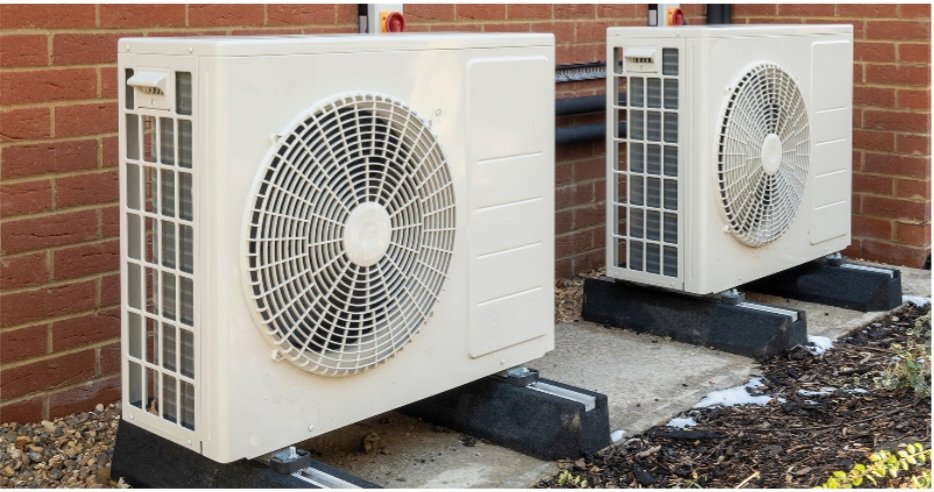
In fact, an air source heat pump is no larger than an outdoor air conditioning unit. It usually sits against an outside wall. In the house, you’ll only need a hot water cylinder, as many already have. Unless you have very little space, a heat pump should be able to fit comfortably.
Bottom line: Heat pumps take up little space. Most houses can fit them quite comfortably.
Myth 7: Heat Pumps Are Difficult to Use
Another myth is that it is hard to use and maintain a heat pump. Actually, they are simple. After installation, the system works automatically. You put in your preferred temperature, and the heat pump works out the rest.
Maintenance is also negligible. An annual tune-up will usually suffice to keep the system running efficiently.
Bottom line: Heat pumps are easy to operate and low-maintenance.
Myth 8: Heat Pumps Do Not Work With Radiators
Many people believe you have to replace all of your radiators to accommodate a heat pump. That is not necessarily true.
Most houses can keep their existing radiators. In a small number of cases, you may need to swap them for slightly larger ones in order to achieve maximum performance. Heat pumps also perform very well with underfloor heating. Installers will visit to assess your property and advise what is needed. Often, adjustments are small and possible.
Bottom line: Heat pumps can be combined with radiators, and upgrades are generally straightforward.
The Bottom Line
There are plenty of myths surrounding air source heat pumps, but there isn’t a single one of them that is true. They function in freezing temperatures. They’re quiet. They can heat older homes. And due to Air Source Heat Pump Grants under ECO4 Scheme, they’re affordable for British families.
If you’re really considering a switch, the best step is to check your eligibility and speak with an installer. Heat pumps are very efficient (you can assume like 300-400%), eco-friendly, and future-proof. They are one of the smartest ways to heat your home in the years ahead.
